
Synapsis AI Triple-patented

Autonomous Clinical Reasoning

Every life is unique. Synapsis AI reasons across decades of records to holistically understand each human patient, at scale.

How it works

From every encounter to a fingerprint of the whole patient

One patient's path to an ATTR diagnosis. Illustrative patient; dates and details are synthetic.

  1. 01 / 07

    Every life is unique.

    Each encounter, interaction and measurement adds to the record. Points of data gather into a single fingerprint.

  2. 02 / 07

    Synapsis AI reasons across decades of records to holistically understand each human patient, at scale.

    Notes, labs, imaging and operative reports become the ridges of the print. Each lit line is an atomic fact: here, a bilateral carpal tunnel release documented in an operative note.

  3. 03 / 07

    The atomic facts of a patient combine into a unique moment in their journey, evolving as their health changes.

    Polyneuropathy clusters with other neuromuscular symptoms. Then hypertension. Findings from different departments and different years, read together.

  4. 04 / 07

    Every signal traced to its source.

    The patient starts to present with advanced heart failure. The fact links back to the report and the date it came from.

  5. 05 / 07

    Synapsis AI finds the clinical signals that get patients the care they need, when they need it.

    The signal reaches a specialist with the evidence from the chart. A PYP scan follows and the patient is diagnosed with ATTR. The clinician makes every decision.

  6. 06 / 07

    The clinical signals form features to project forward in the patient's journey predictively.

    Predictive models trained on a health system's own patients estimate what is likely to happen next, and revise the outlook with each new result.

  7. 07 / 07

    Trained by physicians. Deployed inside your health system. Forming the most complete clinical picture of your patient available.

    Trained and tested by physicians; automates chart review and abstraction with >95% accuracy, outperforming generalist foundation models.

MAR 2019 · OPERATIVE NOTE
Bilateral carpal tunnel releaseATOMIC FACT · MUSCULOSKELETAL
JUN 2021 · NEUROLOGY NOTE, EMG
PolyneuropathyATOMIC FACT · NEUROMUSCULAR
SEP 2022 · BP TREND, PROBLEM LIST
HypertensionATOMIC FACT · CARDIOVASCULAR
FEB 2024 · ECHO REPORT, ADMISSION
Advanced heart failureTRACED TO SOURCE · ECHO REPORT, 02/12/2024
NOV 2026 · SIGNAL SURFACED
PYP scan · ATTR diagnosedNUCLEAR IMAGING REPORT
2029 · PROJECTED
Predicted trajectoryREVISED WITH EACH NEW RESULT
Mission

Saving patients by unlocking the intelligence trapped in millions of medical records to be healthcare's intervention at scale.

Provenance

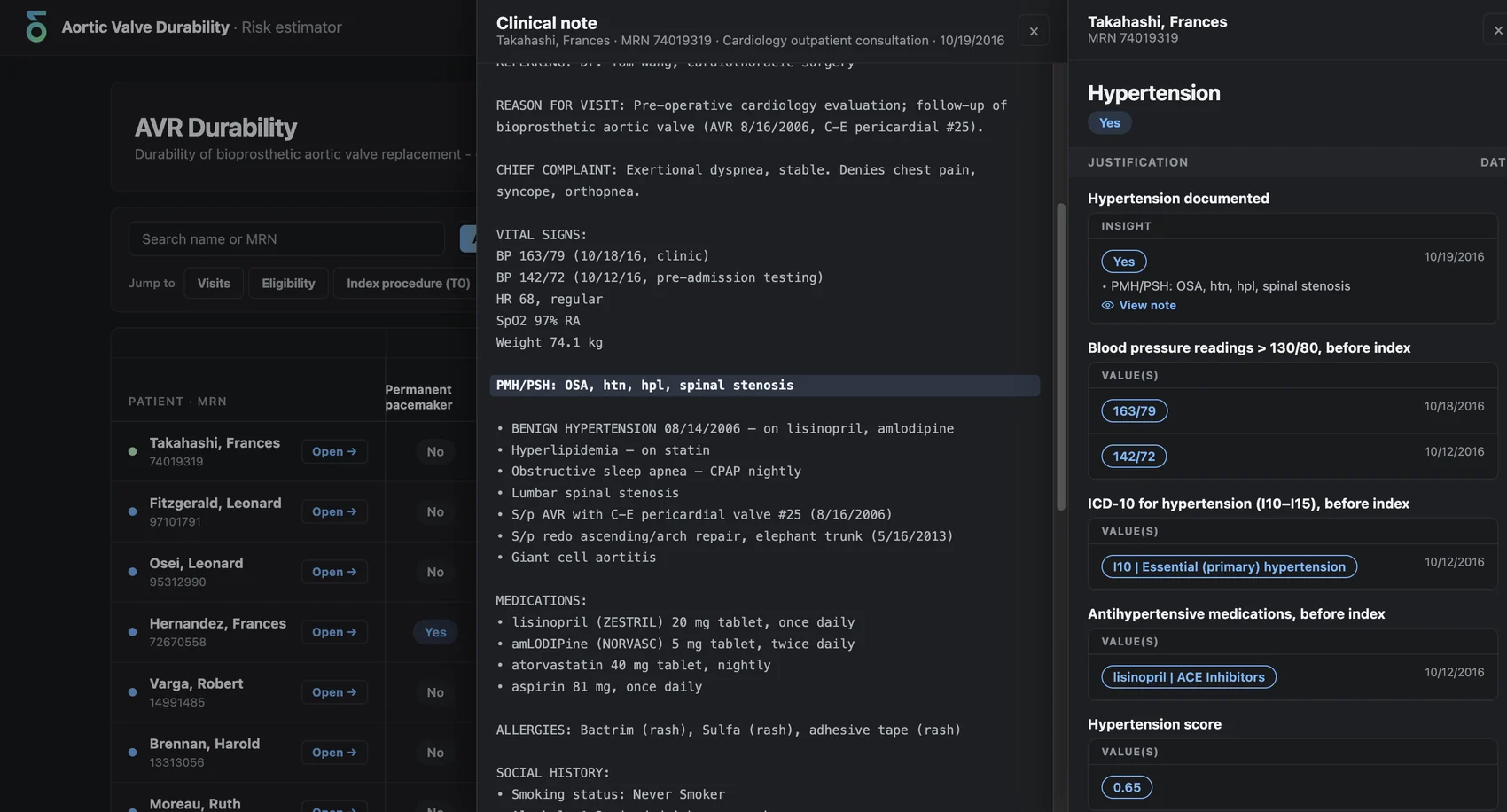
Every clinical signal linked to its provenance with an audit trail providing evidence to every insight.

Hypertension · Control

LAYER 3 · HYPERTENSION Uncontrolled · 158/92

JUSTIFICATIONDATE

Hypertension documented and blood pressure trend

INSIGHT
Uncontrolled · 158/9210/22/26
  • Hypertension: uncontrolled on amlodipine 5 mg daily. BP today 158/92.
  • 3 of 3 readings above 130/80 in the past 24 months
View source

Cross-data reasoning

SIGNAL · SOURCEFINDING
Hypertension documented"PMH: htn" in past medical historyCardiology clinic note · 10/22/26 · unstructured
Yes
Blood pressure readings > 130/80158/92 (10/22/26) · 151/88 (06/03/26) · 147/90 (03/14/25)Vital signs flowsheet · structured
3 / 3
ICD-10 for hypertension (I10–I15)I10 Essential (primary) hypertension · first coded 10/12/2016Problem list · structured
I10
Antihypertensive medicationsamlodipine 5 mg dailyMedication list · structured
1 agent
Hypertension present and uncontrolled on 1 agent · LV afterload modifier
Uncontrolled

Cardiology clinic note

Takahashi, Kenji · MRN 74019319 · 10/22/26

Patient: Takahashi, Kenji · MRN 74019319 · Male, age 72
Encounter: Main campus cardiology, 10/22/26
Return visit scheduled 11/18/26.

History of present illness:
He reports dyspnea on exertion (1 flight), exertional chest tightness.
NYHA CLASSIFICATION: Class III (previously class II, 03/14/25).
Interval history: ed visit · exertional dyspnea · 08/17/26.

Past medical history:
PMH: HTN, HLD, CKD stage 2.Hypertension: uncontrolled on amlodipine 5 mg daily. BP today 158/92.Systolic BP trend: +11 sys / 19 mo.
Antihypertensive agents: 1 agent · amlodipine.
Hypertension duration: 10 yrs.

Cardiac history:
Prior myocardial infarction: None.
Atrial fibrillation: None.
Prior PCI / cardiac surgery: None.

Heart failure symptoms and volume status:
Orthopnea: 2-pillow.
Peripheral edema: 1+ ankle.
Weight change (6 mo): +2 kg.
Loop diuretic: None.
Exercise tolerance: 1 flight.

Triage

The most urgent patients, routed for capacity available now + Synapsis AI driving the right expansion of capacity needed for tomorrow

  • Operating rooms and specialist time are limited. Synapsis AI weeds through the noise, surfaces the signals, and empowers providers to triage patients by severity.
  • Insights flow into human workflows, where care teams adjust sensitivity and specificity so the most urgent patients get the care they need sooner.
  • Finding patients earlier supports preventative care and reduces the volume that reaches specialists late.

Indicative Sample of Disease Applications for Signal Surfacing

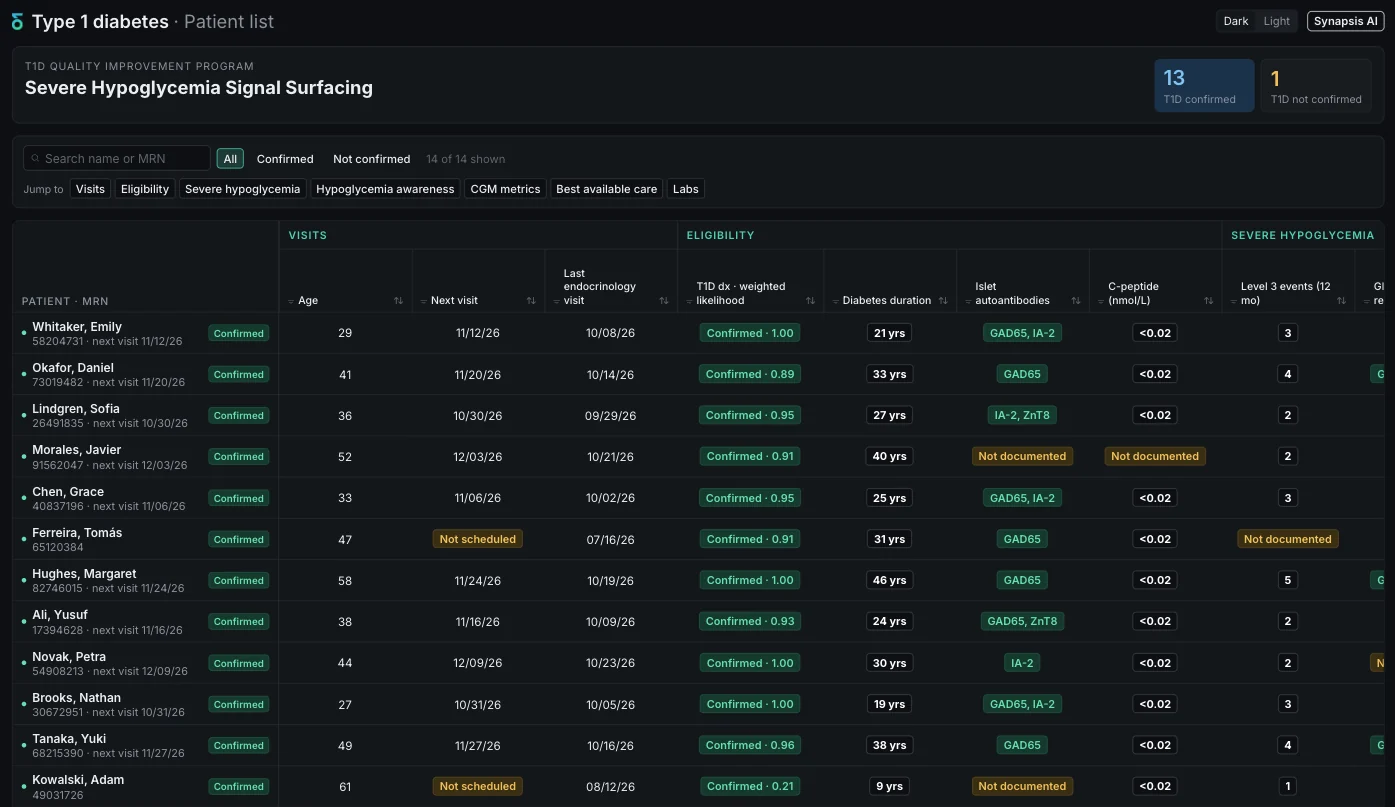
Cardiovascular Surgery· Patient list
AORTIC STENOSIS · AORTIC VALVE REPLACEMENT CANDIDATES
9Patients surfaced
3Urgent
Key signals present
50%
MORE SENSITIVEMORE SPECIFIC
MATCHKEY SIGNALSOTHER SIGNALS
PATIENT · MRNSignals presentAortic valve areaMean gradientPeak velocitySymptomsLVEFHeart failure admission
Demonstration data. Patients shown are synthetic and do not represent real patients.
Synapsis AI Patient Finder

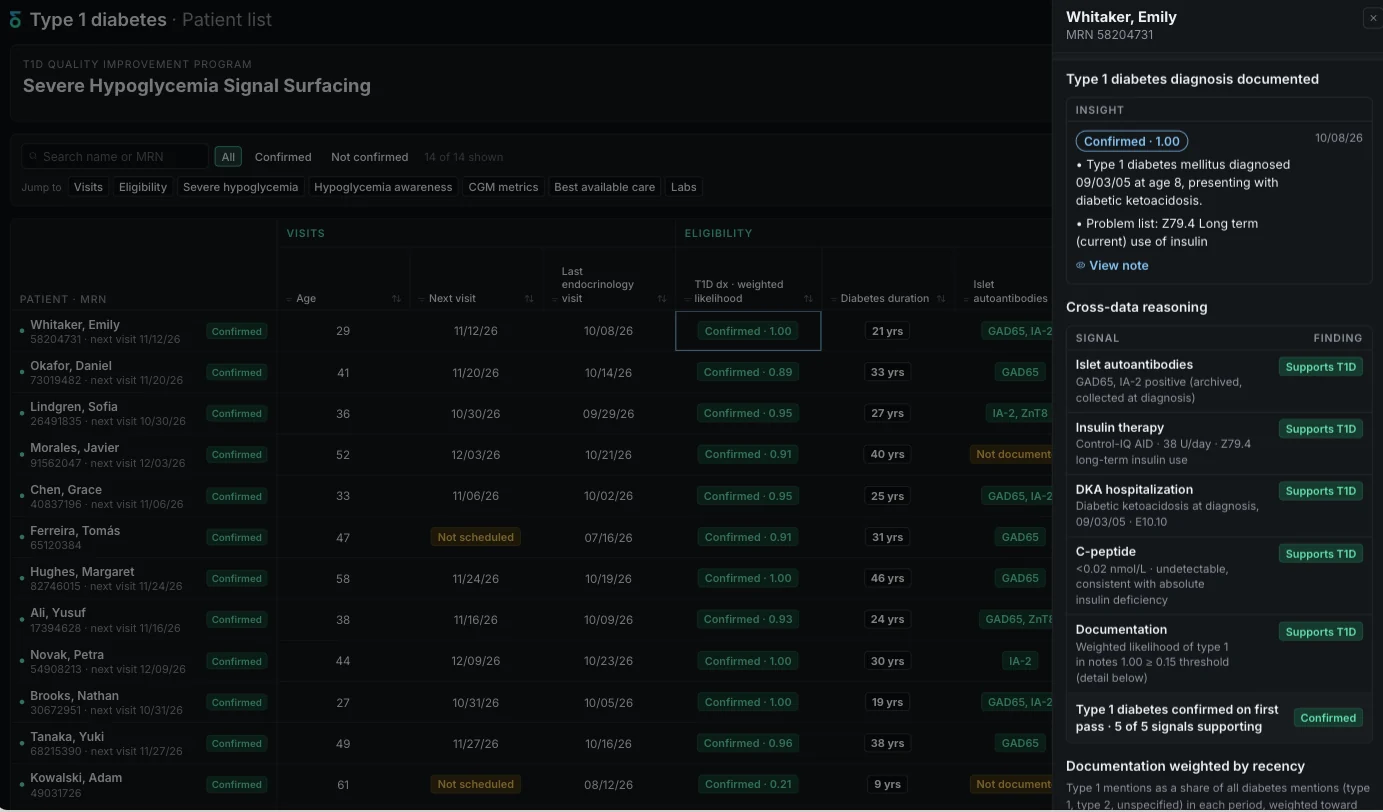
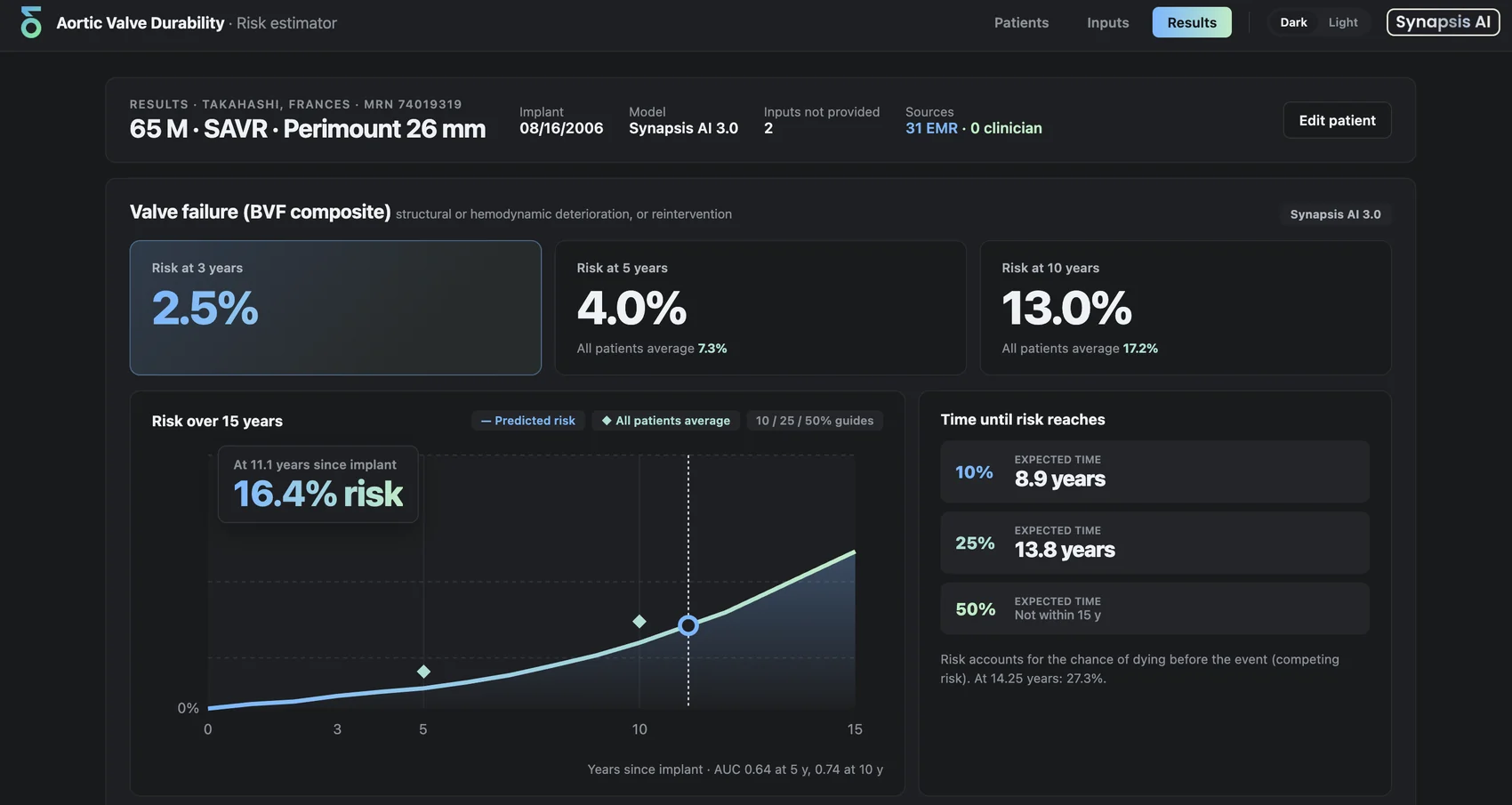
A dynamic and modular interface to meet program-specific applications at scale

Application-specific variations in product can be adapted and configured to human preferences

Signals surfaced across a populationEach patient's characteristics are extracted from the EMR by Synapsis AI.
Cross-data reasoningIndependent signals support the diagnosis, each with its finding.
Traced to the clinical noteThe justification links to the note, the readings, the codes and the medications behind it.
Prediction for the individual patientValve failure risk at 3, 5 and 10 years.

Demonstration data. Patients shown are synthetic and do not represent real patients.

Partners

How our partners use Synapsis AI

  • 01

    Precision Clinical Care

    Find patients who need care they have not yet received and surface the clinical signals for specialists to act on in time.

  • 02

    Registries

    Reporting and quality. Automated chart review and abstraction that is not limited by how many charts a team can read by hand.

  • 03

    Real World Insights & Observational Research

    Detailed clinical datasets built from the full record, so a health system can learn from the patients it has already treated.

  • 04

    Clinical Trials / Interventional Research

    Identify patients who meet trial criteria from the complete longitudinal record, as they become eligible.

Collaboration with NVIDIA

Clinical reasoning AI inside the hospital firewall

Synapsis AI reasons through a patient's complete medical history. NVIDIA accelerated computing makes it possible to do that across large patient populations, on the health system's own infrastructure, without transferring patient records outside it.

CASE STUDY · CLEVELAND CLINIC

Predicting how long replacement heart valves will last

7,812patients with an aortic valve replacement, 2005 to 2021
88clinical questions answered for each patient
16 yrsof patient care reviewed, most of it in narrative notes and echocardiogram reports

The resulting model estimates an individual patient's risk of valve failure and reintervention at three, five and ten years, and revises the outlook with each new ultrasound. The tool is used to help inform care but requires external validation from clinicians.

“Using technology to bring together and analyze information that can help us predict the duration of implanted heart valves is a promising step towards enhanced outcomes and more personalized care for patients.”
Lars G. Svensson, MD, PhD
Chief, Heart, Vascular & Thoracic Institute at Cleveland Clinic
“Dyania Health brings deep clinical expertise to that opportunity, using NVIDIA’s AI platform to support research, help identify gaps in care and build a more complete understanding of patients’ needs.”
Chelsea Sumner
Healthcare AI Startups Ecosystem Lead at NVIDIA

Zero data egress

HOSPITAL PRIVATE NETWORK
  1. The full medical recordYears of notes, operative reports, imaging reports and lab results
  2. Synapsis AIRunning on the hospital's own NVIDIA accelerated computing infrastructure
  3. Care teamsClinical answers with the evidence from the chart, in existing workflows

Inference stays inside the hospital's private network. Synapsis AI does this for every patient in a health system, with no record ever leaving.

Intellectual property

Triple-patented technology

  • UNITED STATES PATENT
    US 12,554,726 B1
    Natural Language Framework for Contextual Entity Identification
    FEB. 17, 2026
  • UNITED STATES PATENT
    US 12,566,769 B1
    Systems and Methods for Conserving Token Use with a Language Model for Contextual Entity Selection
    MAR. 3, 2026
  • UNITED STATES PATENT
    US 12,769,957 B1
    Natural Language Framework for Language Model-Based Entity Identification
    OCT. 20, 2026
Synapsis AIby Dyania Health

Give the next patient the right care sooner.

Partner with us